
By James Wastasecoot
Peguis First Nation marked the National Day for Truth and Reconciliation on Sept. 30 with the opening of the Soaring Eagle Residential School Park, a permanent place to honour survivors, remember the children who never returned home and teach future generations about the residential school system.
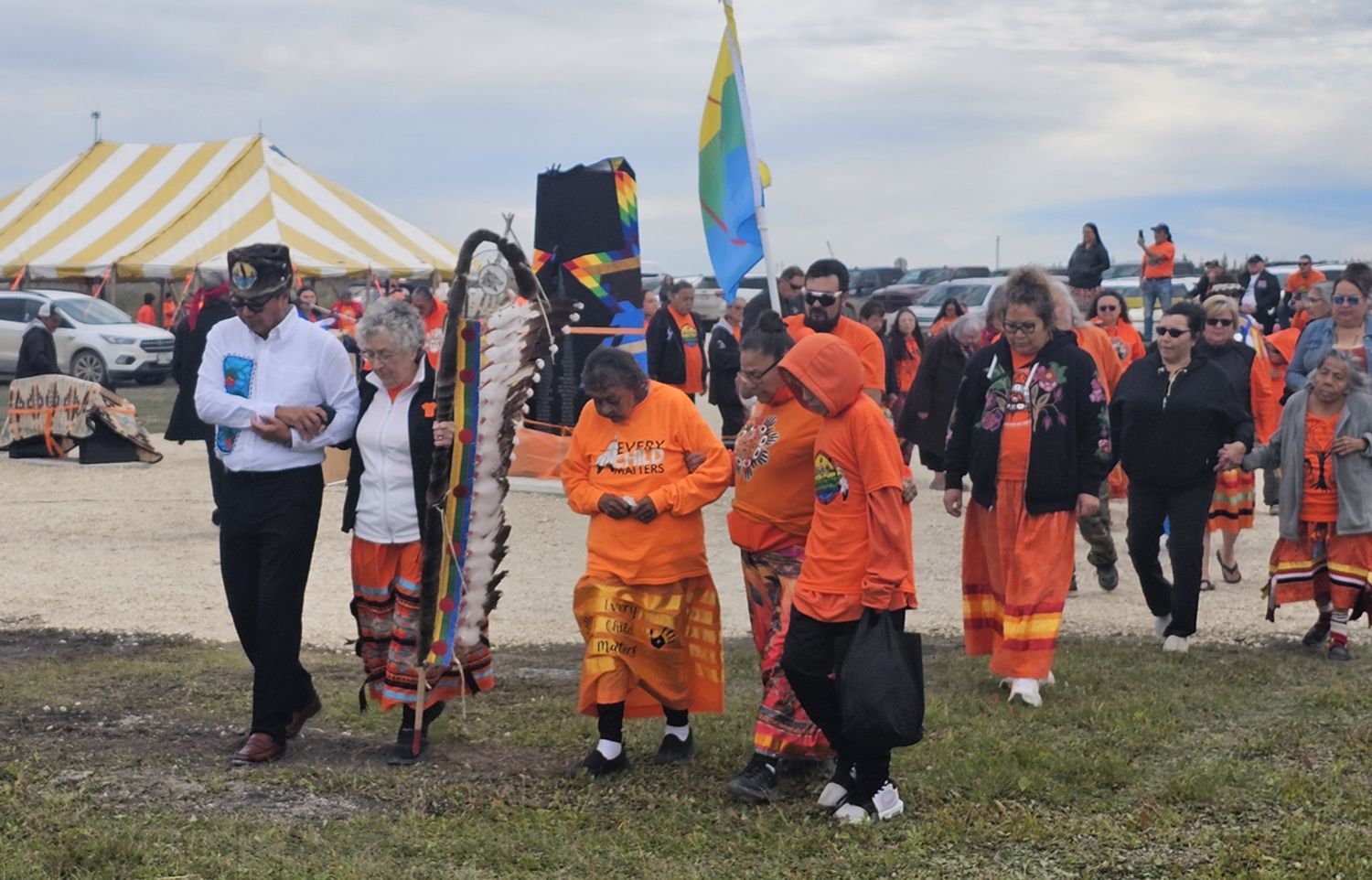
Chief Stan Bird escorts Daphne Thomas as ceremony opening Soaring Eagle park in Peguis.
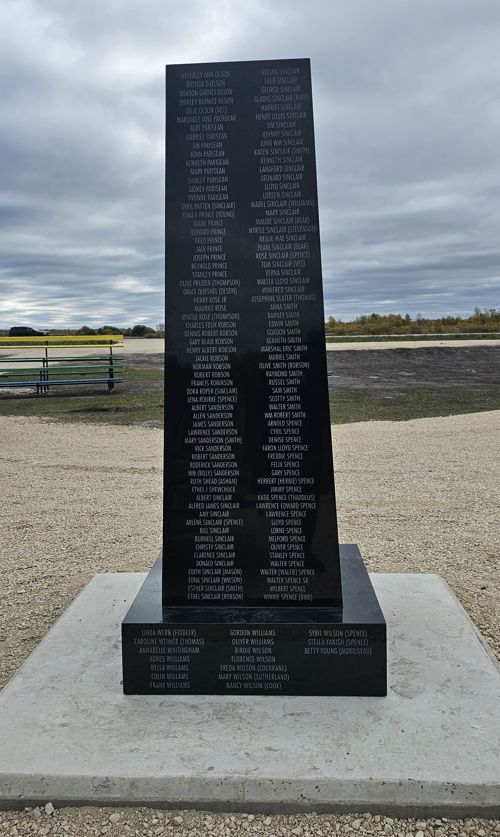
At the centre of the park is a monument bearing the names of more than 600 Peguis people who attended residential and boarding schools at Elkhorn, Dauphin, Portage La Prairie, Birtle, and Brandon. Community members, survivors, descendants, leaders and invited guests gathered for its unveiling and the reading of the names.
The ceremony was both emotional and celebratory. Survivors saw their names permanently recorded, while families found the names of parents and grandparents whose experiences were often kept unspoken for decades.
Peggy Thomas Hedges, 89, described the ceremony and park opening as beautiful but deeply emotional.
“I remembered being in Brandon for those three years and how we were so abused,” she said.
Hedges said she initially had difficulty looking at her own name on the monument.
“At first, I couldn’t see it. I had to shake my head and then I could see it. That’s how emotional it was.”
The monument grew from the work of residential school survivor and elder Daphne Thomas, who spent years fund-raising and persisting in her goal of a residential school memorial in Peguis. More recently, she and co-volunteers and workers spent three years collecting the names that would go on the monument. She appealed through community radio and received telephone calls from families trying to ensure their relatives were included.
“I’m just glad that we got as many as we did,” Thomas told the gathering.
What she first imagined as a small place where people could sit and remember eventually grew into the larger park unveiled Wednesday. Thomas credited Cindy Spence, Phyllis Sutherland and others who helped bring the project to completion.
Sutherland, a key organizer, said the park was named after an eagle appeared while organizers were working at the site.
“All of a sudden, a big eagle soared right over us, and so that’s where we came up with the name Soaring Eagle,” she said.
The park remains a work in progress. Plans include gazebos, benches and a walking path where survivors and their families can sit, reflect and continue their healing journeys.
Sutherland said the park must be more than a physical memorial.
“It is a place of remembrance. It is a place of learning,” she said. “It is a place where our children and grandchildren can come and learn the truth about what happened to our people.”
She told survivors that their lives and experiences matter.
“We see you, we honour you, we believe you, we thank you,” she said. “Thank you for your courage. Thank you for surviving.”
Sutherland said the eagle represents survivors rising above the pain of the past, carrying their stories forward and watching over the children who follow them.
“Let this monument remind us that the names written here will never again be forgotten,” she said.
Chief Stan Bird acknowledged Thomas, Robert Sutherland, Jade Garneau and the late Raymond Mason, Josephine Bear and Winnie Sinclair for bringing the history of residential schools into public discussion at Peguis.
“The conversation had to start in order for today to happen,” Bird said.
He said the monument honours those who were taken from their homes, families and everything familiar to them.
Survivors were forced to speak a foreign language and made to feel ashamed of their identities, but Peguis endured because of their strength.
“It’s because of that indomitable spirit Peguis is still here,” Bird said.
Bird recalled that his father, the late Bill Bird, and several of his uncles attended the Brandon Residential School. His father spoke of children being beaten and of others being taken away and never seen again.
“Only now do I fully understand that those were the cries and tears of a child,” Bird said. “He, like so many others, will not be forgotten.”
The chief said current efforts to revitalize Anishinaabemowin and restore ceremonies are acts of resilience and reclamation. Children must be taught their family histories, their nation, their language and their ceremonies, he said.
Bird also spoke about the meaning of reconciliation, drawing on the words of the late William Thomas, a Brandon Residential School survivor.
“To reconcile means to make things right,” Bird said. “As a people, we have depended upon the government to make things right. The government can never make it right. We must make it right.”
He said that work begins with how families and the community raise, protect and care for children, ensuring they never experience what earlier generations endured.
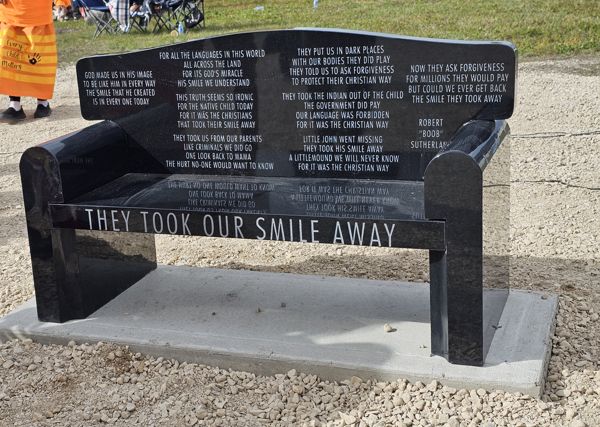
Robert Sutherland read his poem, The Smile They Took Away, which recalls children as young as five or six being removed from their families, forbidden from speaking their language and punished or abused at school.
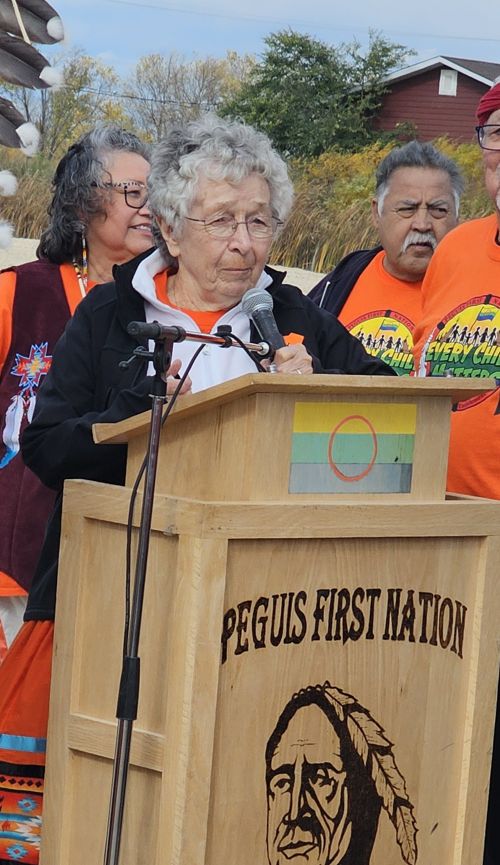
Daphne Thomas speaks at the gathering.
Sutherland said he became interested in the experiences of former residential school students after leaving school in 1964. Some survivors would not speak about what happened, but the late Chief Eddie Thompson agreed to tell him about children arriving unable to speak English and being taught phrases such as “Yes, Father,” “No, Father” and “Forgive me, Father.”
Sutherland’s poem asks whether any settlement or apology could return what was taken from those children.
Manitoba MLA Jennifer Flett, who represents The Pas-Kameesak, thanked survivors for carrying their experiences and helping make possible the resurgence of Indigenous identity, ceremony and public leadership.
“A generation ago, we could not have had drummers. We could not be practising our own ways,” Flett said.
She recalled comforting her young granddaughter, who was crying because she missed her parents. The child knew she would see them the next day, Flett said, but children taken to residential schools had no such assurance.
“That’s when it really hit me, the legacy that the children went through, because they could not see their parents the next day,” she said.
Sherry Daniels found the name of her father, Clarence Daniels, on the monument. Her family had not known it would be included.
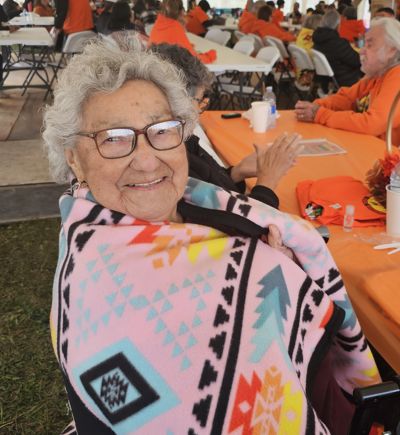
Phyllis Nikoluk
“To see it and to have him acknowledged as a survivor, it made us feel really, really good,” she said. “It’s wonderful to get the community together, especially for Truth and Reconciliation Day, to remember what our families have experienced in the past.”
The Soaring Eagle Residential School Park now gives Peguis a permanent place for that remembrance. It records the names of those who endured the schools, honours those who did not return and reminds coming generations that the survival of Peguis was neither accidental nor assured. It was carried forward by the children who endured, returned home and kept their people’s stories alive.
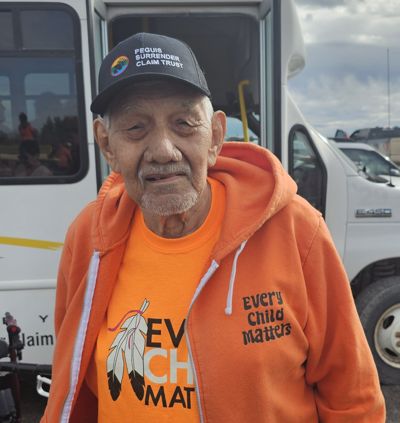
Wilfred Stevenson